Recovery Truck Versus Flatbed Transport Explained
14 September 2026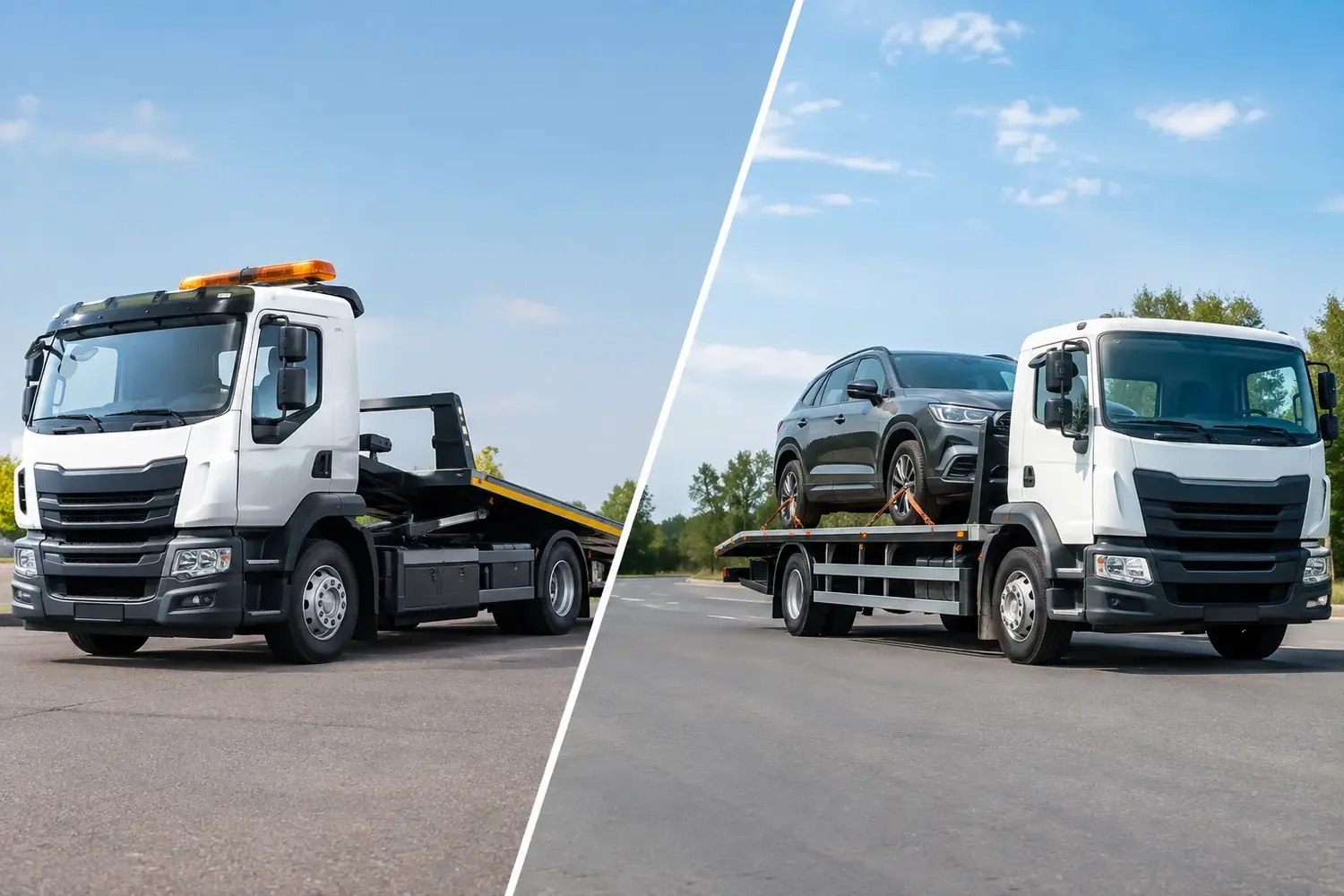
A car that will not start outside your home is one problem. A vehicle with accident damage, a locked wheel or a broken suspension component on a busy motorway is another. The recovery lorry versus flatbed transport decision affects how safely your vehicle can be moved, how quickly the job can be completed and whether further damage is avoided.
For most drivers, the right answer comes down to one question: can the vehicle roll freely and be driven or towed without putting the car, its transmission or other road users at risk? A professional recovery operator will assess that on arrival. You do not need to diagnose the fault before calling, but understanding the difference helps you describe the situation clearly and choose the safest option.
Recovery Lorry Versus Flatbed Transport: The Main Difference
A recovery lorry usually refers to a vehicle fitted with lifting equipment, such as a wheel-lift or spectacle lift. It raises one end of the broken-down vehicle so that the other wheels remain on the road while it is towed. This is often a fast, practical option for straightforward breakdown recovery, particularly when a car is parked safely, its wheels turn freely and the journey to a nearby garage is not complicated.
Flatbed transport, sometimes called full-load recovery, means the entire vehicle is winched or driven on to a flat platform. All four wheels are off the road for the journey. It takes a little more space to load and unload, but it offers the highest level of protection where the vehicle is damaged, low, non-running or unsuitable for conventional towing.
The terms can overlap. Some people use “recovery lorry” to describe any recovery vehicle, including a flatbed. What matters is the recovery method being used - wheel-lift towing or full flatbed transport.
When a Recovery Vehicle Is a Good Fit
A wheel-lift recovery vehicle can be the sensible choice when the car has had a simple mechanical failure and remains safe to tow. For example, a flat battery, a cooling issue that has been made safe, or an engine fault may leave the car unable to continue but otherwise intact.
It is also useful where access is tight. Residential streets, busy car parks and narrow town-centre roads can make it difficult to position a larger flatbed. A recovery operator may be able to lift and remove a vehicle efficiently, reducing the time it is exposed to passing traffic.
This method is not automatically suitable just because the car looks undamaged. The driven wheels, gearbox type and condition of the steering all matter. Towing a vehicle incorrectly can cause expensive transmission damage, especially with automatic, electric, hybrid and four-wheel-drive vehicles. A professional will use the right equipment or recommend flatbed recovery instead.
Situations where towing may be appropriate
A standard recovery method is often considered where the vehicle has a minor fault, the tyres are inflated, the steering is intact and no major collision damage is visible. It can be particularly practical for a short recovery to a local garage or a safe address.
Even then, the decision is made after an on-site check. If the operator finds a seized wheel, damaged suspension, a transmission concern or any sign that the car may not track safely behind the recovery vehicle, full loading becomes the safer route.
When Flatbed Transport Is the Safer Choice
Flatbed transport is generally the preferred option after an accident, when a car will not roll, or when there is any doubt about its roadworthiness. Keeping the whole vehicle on the deck prevents its wheels and drivetrain from turning during transport.
It is particularly valuable for vehicles with low ground clearance, performance cars, classics and prestige vehicles. These vehicles can be more vulnerable to scraping, bumper damage or mechanical strain during loading and towing. A carefully operated flatbed, with suitable ramps and winching equipment, gives far more control.
Flatbed recovery is also often the right answer for electric and hybrid vehicles. Their high-voltage systems, weight distribution and manufacturer recovery guidance can differ from petrol or diesel cars. If the vehicle has suffered impact damage, warning lights, battery damage or is not safe to select neutral, do not attempt to move it yourself. Tell the recovery provider exactly what has happened.
Damage that calls for full loading
A flatbed should be strongly considered if the vehicle has collision damage, a wheel pointing at an unusual angle, a tyre that has come off the rim, broken steering or suspension, or fluid leaking beneath it. The same applies if the vehicle is stuck in park, cannot be put into neutral, has locked wheels or has been declared unsafe to drive.
Four-wheel-drive cars are another important case. Many cannot be towed with one axle lifted because the remaining wheels turning on the road may damage the drivetrain. Full flatbed transport avoids that risk. If you are unsure whether your vehicle is two-wheel drive, all-wheel drive or four-wheel drive, say so when booking and provide the make and model.
Cost, Speed and Access: The Real Trade-Offs
A recovery lorry using a wheel-lift can sometimes be quicker to dispatch and simpler to use for a straightforward local tow. Loading may take less time, especially where the vehicle can be reached easily and there is limited space. That can make it a cost-effective option for minor breakdowns.
Flatbed work can involve a larger vehicle, more careful positioning and longer loading time. It may cost more, particularly for a longer-distance transport or difficult recovery. But price should not be the only consideration. Choosing the cheaper method for a vehicle that cannot safely be towed can lead to more damage, delays and a larger repair bill.
Access can change the plan too. A car in a multi-storey car park, underground bay or narrow lane may not be reachable by a flatbed. In those cases, a recovery operator may use specialist equipment to move the vehicle to a suitable loading point before arranging onward transport. Clear information before dispatch helps prevent wasted time.
What to Tell the Recovery Operator
The fastest way to get the correct vehicle sent is to give a clear, honest description of the problem. Tell the operator whether the car starts, rolls, steers and can go into neutral. Mention visible damage, warning lights, leaking fluid, flat tyres, wheel damage and whether the vehicle is automatic, electric, hybrid or four-wheel drive.
Your exact location matters just as much. If you are on a motorway or dual carriageway, provide the road number, direction of travel, the nearest junction, marker post or recognisable landmark. On ordinary roads, give the postcode if possible and explain whether the vehicle is in a live lane, on the hard shoulder, in a car park or outside a property.
If you have passengers, children, pets or a medical concern, say so at the start of the call. The recovery plan may need to include safe onward travel rather than simply moving the vehicle. A responsive service should keep you updated with an estimated arrival time and let you know what to expect when help is on the way.
Stay Safe While You Wait
Do not stand between your vehicle and moving traffic, and do not try to inspect damage on the roadside if it puts you in danger. On a motorway, move behind a barrier if it is safe to do so. If the car can be left safely, keep well away from traffic and call for assistance.
Do not attempt to tow the vehicle with a rope, especially after an accident or if the vehicle has steering, brake, wheel or suspension damage. Modern cars are not all suited to improvised towing, and a short journey can make a manageable fault much worse.
If you are stranded in Manchester, Liverpool, Glasgow, Preston or Coventry, an operator such as Car Recovery 24 can assess the situation and dispatch the appropriate recovery vehicle with clear updates. The aim is not simply to move the car quickly, but to move it in the way that keeps you safe and protects it from further harm.
When you call, describe what you can see, then let the recovery professional decide between a wheel-lift and a flatbed. That calm, practical choice is often the difference between a straightforward recovery and an avoidable repair.