Mobile Tyre Fitting Roadside: What to Do First
23 August 2026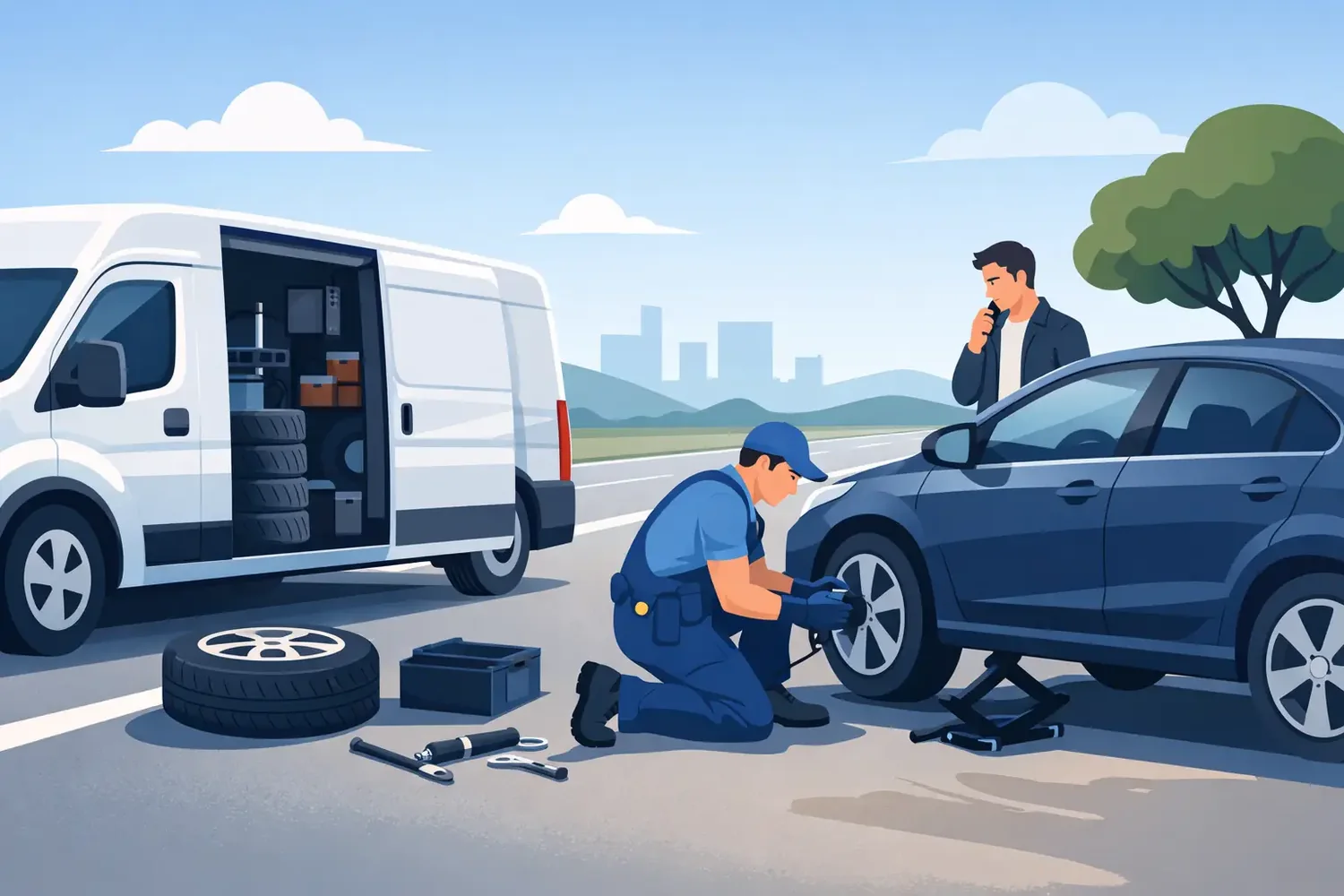
A flat tyre can turn a normal journey into a stressful stop within seconds. Whether you are outside Glasgow in the rain, on your commute, or travelling with children, mobile tyre fitting roadside support gives you a practical alternative to struggling with a wheel at the kerbside. The first priority is not getting the tyre changed quickly. It is getting you and your passengers somewhere safe while help is arranged.
Make the vehicle safe before arranging help
As soon as you notice a puncture, a tyre-pressure warning light, heavy vibration or pulling through the steering, slow down smoothly. Avoid sharp braking or sudden steering movements. Signal early and move to a safe place away from moving traffic if the vehicle is still controllable.
Put on your hazard lights, apply the handbrake and switch off the engine once parked. If you are on an ordinary road, choose a well-lit lay-by, car park or wide, safe verge where possible. Do not stop on a bend, close to a junction or somewhere drivers will struggle to see you.
A motorway or smart motorway needs extra care. Never attempt to change a wheel on the hard shoulder or in a live lane. If you can reach an emergency area safely, do so. If your vehicle stops in a live lane and cannot be moved, keep your seatbelt on, switch on hazard lights and call 999. Follow the advice given by the emergency services or traffic officers.
Once you are safe, tell the assistance provider exactly where you are. A road name is helpful, but the direction of travel, a nearby landmark, a junction number or a live location shared through WhatsApp can make dispatch much quicker.
When mobile tyre fitting roadside is the right answer
Roadside tyre assistance is useful when the tyre has lost pressure unexpectedly and the vehicle cannot safely continue. That could mean a nail or screw in the tread, sidewall damage after a pothole impact, a split tyre, a damaged valve, or a wheel that has been driven on while flat.
A trained technician can assess the condition of the tyre, check whether there is a usable spare wheel and fit it correctly where conditions allow. They can also inspect obvious wheel damage and make sure the replacement wheel is tightened to the correct standard before you leave. This is particularly helpful if you do not have the tools, are unsure how to use a jack, or are parked somewhere unsuitable for a DIY repair.
It does depend on the vehicle and the damage. Many newer cars have no spare wheel at all, only a tyre repair kit. A sealant kit may offer a temporary solution for a small tread puncture, but it will not repair cuts, sidewall damage, a badly damaged tyre or a tyre that has come off the rim. In those cases, recovery to a tyre centre or another safe destination may be the sensible option.
Run-flat tyres also need professional judgement. They may allow limited driving after pressure loss, but only within the vehicle manufacturer’s stated speed and distance limits. Continuing further than permitted can damage the tyre internally and may risk the wheel as well.
What a roadside tyre technician will need to know
Clear information helps the right vehicle and equipment reach you without delay. When you call, be ready to explain which tyre is affected if you know it, such as front near-side or rear off-side. Mention whether the tyre is fully flat, whether there has been an impact, and whether you have a spare wheel in the vehicle.
It also helps to provide the vehicle make, model, registration and your exact location. If you are in a car park, say which entrance or level you are near. If you are on a dual carriageway, confirm the direction you are travelling and the nearest exit, bridge number or landmark. These details reduce time spent searching for a stranded vehicle.
Do not worry if you cannot identify the cause of the puncture. Avoid pulling out a nail or screw from the tread. It may be slowing the air loss, and removing it can leave the tyre completely flat before help arrives. A quick photograph can be useful if it is safe to take one, but never stand close to traffic to inspect the tyre.
Why changing a wheel yourself is not always safer
Changing a tyre is straightforward only when the ground is level, the vehicle is stable, traffic is well away and you have the correct spare, locking wheel nut key and tools. In real roadside conditions, one or more of those things is often missing.
The vehicle can move if it is not properly secured. A jack can slip on soft ground, gravel or an uneven kerb. Wheel bolts may be overtightened, corroded or impossible to remove with the standard wheel brace. Some vehicles need specific jacking points, and lifting in the wrong place can cause expensive damage.
There is also the issue of the spare itself. A space-saver wheel is normally intended for temporary use and may have a lower speed limit. An old full-size spare may look fine but have low pressure, cracks or perished rubber. A roadside professional can spot these issues and advise whether the vehicle is safe to drive or should be recovered instead.
What happens if there is no spare tyre
No spare wheel does not mean you are stuck without options. First, the technician will assess whether the tyre can be temporarily reinflated or whether a repair kit is appropriate. This depends on the location and type of damage, as well as the tyre’s condition.
If the tyre cannot be made safe, vehicle recovery is usually the next step. The car can be transported to a tyre garage, your home, a dealership or another agreed location, depending on the situation. This avoids the risk of driving on a flat tyre, which can rapidly destroy the sidewall and potentially damage the alloy wheel.
For electric and hybrid vehicles, recovery also needs proper handling. Their weight, towing requirements and transport procedures can differ from conventional cars. Let the recovery provider know the vehicle type when you call so the right arrangements can be made.
Simple checks that can prevent a roadside stop
Most punctures cannot be predicted, especially after hitting debris or a pothole. However, a few basic checks can reduce the chance of being caught out. Check tyre pressures at least once a month and before a long trip, using the pressure figures shown on the vehicle’s tyre label or handbook. Do this when the tyres are cold.
Look over the tread and sidewalls for nails, bulges, cuts and unusual wear. A tyre that repeatedly loses pressure needs attention even if it can be pumped back up. It may have a slow puncture, a damaged valve or a sealing issue around the wheel rim.
It is also worth checking that your locking wheel nut key is in the vehicle and that any spare wheel is inflated. Many drivers only discover a missing key or flat spare at the worst possible moment. Keeping these items together in the boot can save valuable time.
Fast communication matters when you are stranded
During a tyre emergency, vague arrival windows add to the stress. You need to know that help is on the way, where it is coming from and what will happen when the technician arrives. Clear updates let you make sensible decisions, especially if you are with children, parked after dark or waiting somewhere exposed.
At Car Recovery 24, the focus is on practical 24-hour help, direct communication and clear ETA updates, so you are not left wondering what is happening next. The aim is always to assess the tyre situation safely, get you moving where possible and arrange professional recovery when driving on is not the right option.
A puncture is inconvenient, but it does not need to become a dangerous roadside problem. Stay visible, get to the safest available location, share an accurate location and leave the wheel work to someone equipped to handle it properly.