How to Stay Safe After a Breakdown on UK Roads
16 July 2026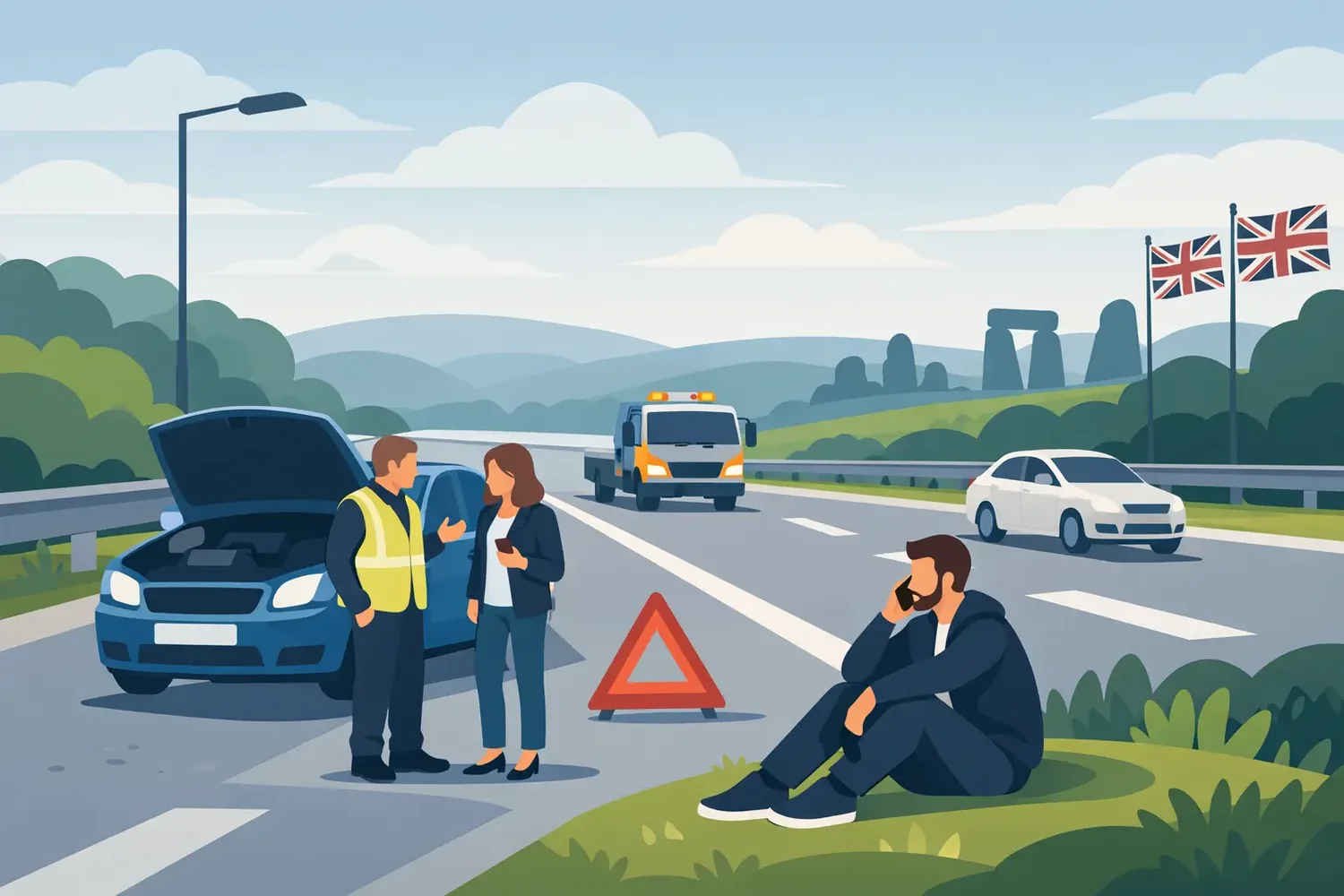
A breakdown can turn a normal drive into a stressful situation in seconds. Knowing how to stay safe after a breakdown gives you a clear order of priorities: get out of danger where possible, protect the people in the vehicle, and get professional help on the way. The fault itself can wait. Your safety cannot.
First, get your vehicle to the safest available place
If the car is still moving and it is safe to do so, steer calmly towards a safe stopping place. A service area, petrol station, lay-by or quiet side road is usually far better than stopping on a busy carriageway. Avoid sudden braking or sharp steering, especially if you have a tyre problem, loss of power steering or a warning light that has appeared without warning.
Turn on your hazard warning lights as soon as other road users need to know you are slowing down or stopping unexpectedly. If you can make it to a place away from moving traffic, park as far from the road as practical, apply the handbrake and switch off the engine. Put the vehicle in gear if it is a manual, or Park if it is automatic.
Do not keep driving simply because the car will still move. Continuing with an overheating engine, flat tyre, serious warning light, burning smell or loss of braking performance can make a repair more expensive and put you at greater risk. A short delay for recovery is usually the safer option.
How to stay safe after a breakdown on a motorway
Motorways and fast dual carriageways need extra care because vehicles pass at high speed. If you notice a problem early, try to leave at the next junction or pull into a service area. If that is not possible, stop as far left as you can, ideally in an emergency area, lay-by or hard shoulder where one is available.
Once stopped, keep your hazard lights on. If you are on a conventional motorway hard shoulder and it is safe to leave, exit the vehicle through the left-hand passenger door and wait behind the barrier, well away from the carriageway. Keep children close and do not allow anyone to stand between the car and moving traffic.
Smart motorways require a different response. An emergency area is the safest option if you can reach one. If your vehicle has stopped in a live lane and cannot be moved, switch on hazard lights, keep seatbelts fastened and call 999 straight away. Do not attempt to walk along live lanes. Leave the vehicle only if there is an immediate danger, such as fire, and it is safe to do so.
Never place a warning triangle on a motorway. On other roads, a triangle can sometimes help alert approaching drivers, but only use one if you can place it without putting yourself near fast-moving traffic. Your safety is never worth a few extra seconds of warning.
Make the right call without delay
Call 999 first if anyone is injured, you are stranded in a live motorway lane, there is a fire, smoke, a fuel leak, or the vehicle is creating an immediate danger to traffic. Tell the operator exactly where you are, the direction you were travelling and whether vulnerable passengers are with you.
For a non-emergency breakdown, contact a reliable recovery provider as soon as you are in a safe position. Waiting to see whether the engine restarts can waste time and may leave you in a less safe location after dark or in poor weather.
When you call, have the following details ready:
- Your registration number, vehicle make and model
- Your exact location, road number, postcode, junction number or motorway marker
- The direction you are travelling and any nearby landmark
- What has happened, such as a flat battery, puncture, overheating or warning light
- Whether children, elderly passengers or pets are with you
- Any access issues, such as being in a multi-storey car park or narrow street
Clear information helps the recovery team send the right vehicle and equipment first time. A battery jumpstart, tyre change, fluid top-up or vehicle recovery all need a slightly different response.
Keep passengers safe while you wait
If you have stopped somewhere away from traffic, move everyone to a safe place nearby, such as behind a barrier, inside a service station or well back from the roadside. On a quiet road with no safe area to wait, stay alert to passing vehicles and avoid opening doors towards traffic.
Children should remain supervised at all times. A breakdown can feel frightening, particularly at night, so give simple instructions and keep everyone together. If weather conditions are poor, use coats, blankets or spare clothing from the car, but do not run the engine merely to stay warm if there is a possibility of exhaust fumes entering the vehicle.
At night, make yourself visible without putting yourself in danger. High-visibility clothing can help if you need to leave the car safely, but it does not make standing close to traffic safe. Keep a torch or charged phone light available, and avoid using the torch in a way that distracts approaching drivers.
If you are waiting in the vehicle because it is the safest choice, lock the doors and keep your phone charged. Use your hazards when appropriate, but be aware that they can drain a weak battery over a long wait. A recovery operator can advise you based on your location and the condition of the vehicle.
Do not try to fix a dangerous roadside fault
Some issues are straightforward in the right place. Replacing a wheel on level ground away from traffic, for example, may be possible if you have the correct tools and know what you are doing. But a roadside repair becomes unsafe quickly when there is poor visibility, rain, uneven ground, fast traffic or a vehicle that is not securely positioned.
Do not look underneath a vehicle on the roadside. Do not touch leaking fluid, attempt to repair damaged electrical wiring or open a radiator cap on an overheated engine. Hot coolant can cause serious burns, and a leak may be more serious than it first appears.
It also makes sense to avoid accepting help from someone who seems pushy or asks for cash before explaining what they will do. A legitimate recovery provider should identify themselves, confirm the vehicle details and communicate clearly about the work or recovery plan. If you are unsure, keep the doors locked and speak through a slightly opened window or by phone.
Stay visible, stay informed and protect your phone battery
Your phone is your lifeline during a breakdown. Send your location to a family member or friend if you are alone, and keep the recovery provider updated if you have to move location. If you are waiting for assistance from Car Recovery 24, clear location details and live communication can help the driver reach you without unnecessary delays.
Use low-power mode, close apps you do not need and avoid long calls where possible. A car charger or power bank is worth keeping in the vehicle, especially for regular motorway journeys, winter travel or late-night commuting.
Be cautious with location descriptions. Saying you are “near Glasgow” is not enough for a fast response. Give the road name, nearest junction, direction of travel and visible signs. On motorways, the small blue location marker signs can be particularly useful because they identify the exact stretch of road.
Be ready for changing weather and traffic conditions
A breakdown in daylight on a quiet road is one thing. The same fault in heavy rain, ice, fog or rush-hour traffic needs more caution. Wet roads make it harder for other vehicles to stop, while fog can hide a stationary car until the last moment.
In winter, keep a small emergency kit in the vehicle: warm layers, water, a torch, charging cable, high-visibility vest and basic first-aid supplies. This is not about turning your car into a workshop. It is about staying comfortable and contactable while trained help is on its way.
If your vehicle is blocking a narrow road, blind bend or driveway, tell the recovery operator immediately. They may need to prioritise the job differently or arrange the right type of recovery vehicle. Do not stand in the road trying to direct traffic unless emergency services instruct you to do so.
Before you set off again
When help arrives, explain exactly what happened and mention anything unusual you noticed before the breakdown, including smells, noises, dashboard warnings or changes in steering and braking. Small details can help identify whether a safe roadside repair is possible or whether the vehicle should be recovered.
Do not feel pressured to continue your journey if you are tired, shaken or the vehicle does not feel right. Recovery is not a failure - it is often the sensible decision that prevents a minor fault becoming a dangerous situation. Once you and your passengers are safe, the next step can be taken calmly, with the right support in place.