How to Handle a Flat Tyre at the Roadside
1 August 2026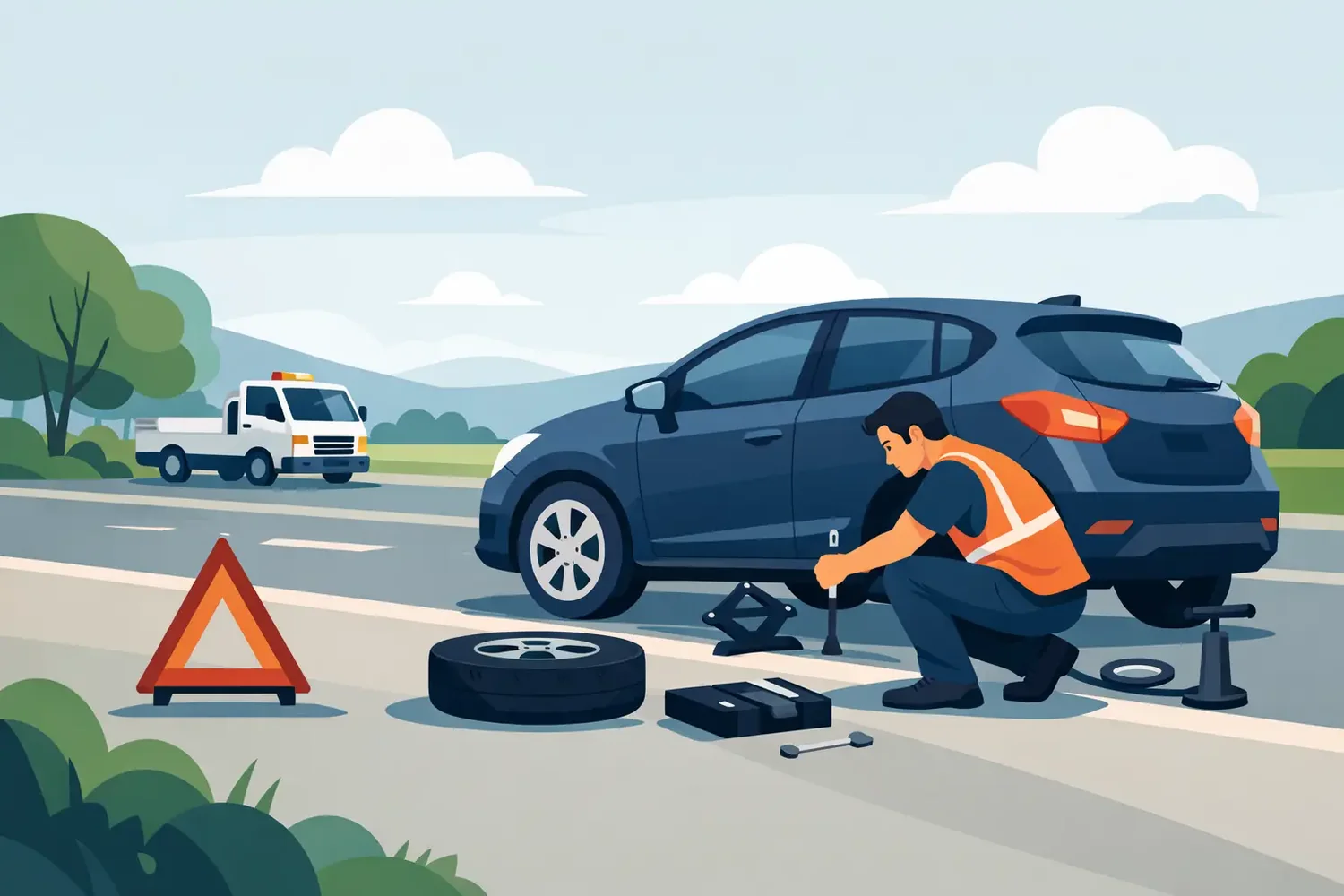
A tyre can fail without much warning. One moment you are on your way to work, collecting the children or heading home after a long journey; the next, the steering feels heavy, the car pulls to one side, or you hear the unmistakable flap of a deflated tyre. Knowing how to handle flat tyre roadside situations calmly can protect you, your passengers and other road users.
Your first priority is not getting the wheel changed quickly. It is getting yourself to a safe place. A roadside tyre change is often possible on a quiet road with enough space, but it is not always the right option. Heavy traffic, poor visibility, a narrow verge or a motorway hard shoulder all change the decision.
Stop safely before dealing with the tyre
If you suspect a puncture, keep a firm grip on the steering wheel and slow down gradually. Avoid sharp braking, sudden turns or trying to carry on at normal speed. Put your hazard warning lights on once you are slowing down and look for a safe, level place to stop away from moving traffic.
On a normal road, aim for a lay-by, car park, quiet side road or a wide, firm verge. Do not stop on a bend, at the brow of a hill, close to a junction or anywhere drivers may not see you until the last second. Once parked, apply the handbrake, select first gear or Park, switch on the hazard lights and turn the wheels slightly away from the road if it is safe to do so.
If you are on a motorway, smart motorway or fast dual carriageway, do not attempt to change the wheel beside live traffic. Move to an emergency area, service station or motorway exit if the vehicle remains controllable and it is safe to do so. If you must stop on the hard shoulder, pull as far left as possible, leave the car by the left-hand doors and wait behind the safety barrier, well away from the traffic. Call for help straight away. If you are in immediate danger or cannot leave the vehicle safely, call 999.
Check whether a roadside tyre change is sensible
Before opening the boot, take a moment to assess the location, weather and condition of the tyre. A straightforward puncture on a quiet, flat road is very different from a damaged tyre on a wet country lane after dark.
You may be able to use the spare if you have one, the ground is firm and level, and there is enough safe space to work on the side of the vehicle away from traffic. Check your handbook if you are unsure where the jacking points are or what type of spare your vehicle carries.
Call for roadside assistance instead if the road feels unsafe, you do not have the correct tools, the wheel nuts are seized, you have more than one damaged tyre, or the tyre has come off the rim. It is also sensible to get professional help if you are travelling with children, are alone in poor conditions, or simply do not feel confident lifting the vehicle.
A flat tyre can also be a symptom rather than the whole problem. A split sidewall, cracked alloy, damaged valve, broken wheel stud or impact from a deep pothole may mean a spare wheel is not a safe long-term answer.
How to handle a flat tyre roadside with a spare wheel
If the location is safe and you have decided to fit the spare, work methodically. Keep passengers away from the vehicle and out of the road. Put on a high-visibility jacket if you have one, but do not walk around in live traffic to retrieve it.
You will normally need the spare wheel, locking wheel nut key if fitted, wheel brace and jack. Some vehicles have tyre sealant and an inflator instead of a spare, so check before assuming a wheel is available.
Follow these steps carefully:
- Secure the vehicle. Apply the handbrake fully, leave the vehicle in gear or Park, and use wheel chocks if you have them. Never rely on the jack alone to hold a car safely.
- Find the correct jacking point. Your vehicle handbook shows the reinforced points under the sill. Placing a jack in the wrong area can damage the bodywork or allow the vehicle to slip.
- Loosen the wheel nuts before lifting. Remove the hubcap if necessary, fit the locking wheel nut key where required, and loosen each nut by a small amount while the tyre is still on the ground. Do not remove the nuts completely yet.
- Raise the vehicle only enough to clear the ground. Position the jack on firm, level ground. Avoid soft verges, loose gravel or sloping surfaces. If the jack starts leaning or sinking, stop and call for assistance.
- Fit the spare and tighten the nuts evenly. Remove the damaged wheel, place the spare onto the hub and hand-tighten the nuts. Lower the car carefully, then tighten the nuts in a diagonal pattern rather than going around the wheel in a circle.
Put the damaged wheel and tools back securely before driving away. Check the spare looks properly inflated. If it is low, do not risk driving on it.
Do not drive normally on a space-saver spare
Many modern cars have a narrow temporary spare, often called a space-saver. These are designed to get you to a tyre fitter or safe repair location, not to carry on with your journey as usual. There should be a speed limit printed on the tyre or wheel label, commonly 50 mph. Keep your speed down, avoid long distances where possible, and do not use it for towing.
The car may handle differently with a temporary spare, particularly in wet weather or when braking. If the warning light remains on after the wheel is fitted, that can be normal on some vehicles, but it still needs checking once a proper tyre is installed.
Can tyre sealant fix a puncture?
A tyre sealant kit can be useful for a small puncture in the central tread area. It is not a fix for every flat tyre. It will not reliably repair a sidewall cut, a tyre that has been driven flat, a damaged wheel or a large hole caused by road debris.
Read the instructions on the sealant bottle and compressor carefully. Most kits involve connecting the sealant to the tyre valve, inflating the tyre, then driving a short distance so the product can spread inside. You must then check the pressure again and arrange a proper inspection as soon as possible.
Tell the tyre fitter that sealant has been used. Some punctures can still be repaired, while others will require a replacement tyre. Driving on a deflated tyre, even for a short distance, can damage its internal structure and usually makes repair less likely.
What not to do when you have a flat tyre
Do not keep driving in the hope that the tyre will hold air until you reach home. A tyre that is visibly flat can overheat, break apart and damage the wheel, suspension or bodywork. Stopping sooner can save a costly recovery and repair.
Do not put any part of your body underneath a vehicle supported only by a jack. Do not use loose bricks, logs or unstable objects to support the car. And do not force wheel nuts with excessive jumping or leverage if they will not move. A slipped tool can cause injury, and damaged studs can turn a tyre change into a recovery job.
If you have hit a pothole or kerb, inspect the other tyres as well once you are safely stopped. A bulge in the sidewall, deep cut, exposed cords or distorted wheel means the vehicle should not be driven normally.
When calling roadside assistance is the safer choice
There is no prize for changing a wheel in difficult conditions. Fast professional help is often the safest option, especially at night, in heavy rain, on busy roads or when you are unsure what has caused the loss of pressure.
When you call, give your exact location, vehicle registration, tyre position if you know it, and whether you have a usable spare. Mention if you are on a motorway, carrying children, blocking a road or in an unsafe position. This helps the recovery operator send the right support and give you a realistic arrival update.
Car Recovery 24 can provide 24-hour roadside tyre assistance and recovery support across the UK, with rapid help available around Glasgow and throughout Scotland. If a roadside wheel change is not safe or your car cannot continue, the vehicle can be recovered rather than left stranded.
A puncture is frustrating, but it does not need to become a dangerous situation. Put distance between yourself and traffic, make the safe call rather than the quick call, and let the journey wait until the vehicle is ready to move again.